Italian Coffee Rules: Cappuccino after 11? Not Likely.

If in Italy, you have a better chance of having Michelangelo paint your portrait than having a cappuccino past 11. The question of course, is why? Why the strict cutoff? Well, it has everything to do with the Italian obsession with digestion.
Italians are not well-known for efficiency, organization, or strict schedules. However, when it coffee, there is an order to things, with Italian coffee rules to be respected – and on many, many of these matters, there is no grey area.
Italian Coffee Rules – No Espresso after 11
One such matter is Italian coffee rules that state there should be no cappuccino after 11am. If in Italy, you have a better chance of having Michelangelo paint your portrait than having a cappuccino past 11. The question of course, is why? Why the strict cutoff? Well, it has everything to do with the Italian obsession with digestion.
That’s right, Italians are fixated on digestion: There is no swimming for three hours after lunch, there is a whole section of alcoholic spirits labeled as “digestivo”, salads are served after the meal because “it aids digestion”, and every home is equipped with Brioschi, the Italian effervescent antacid. Walks or getting up from the table to move about is also commonplace – “you have to move the body, to get the stomach moving” one of our uncles would say, amaro in hand, after the plates were cleared.
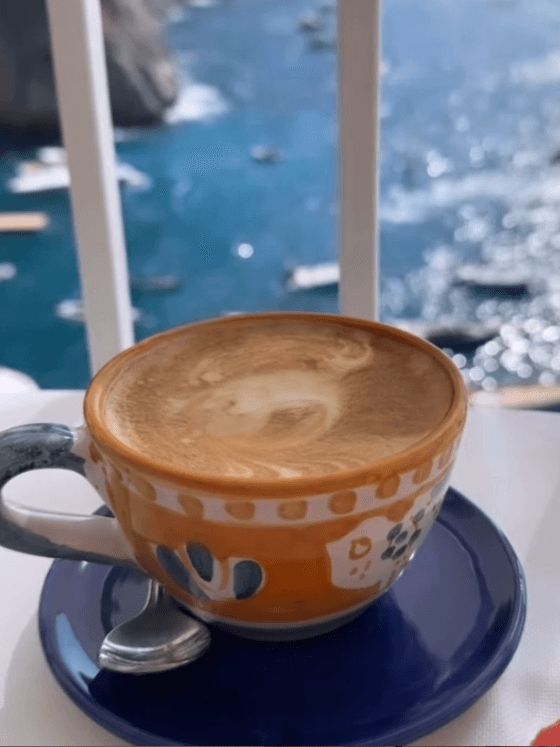
So, what does digestion have to do with a cappuccino after 11am? It’s the milk – it’s too heavy for the stomach, so if you are to enjoy a cappuccino, it should be in the morning, when the stomach can handle the milk and the coffee.

In “Why Won’t Italians Have Cappuccino After Dinner?” Amanda Ruggeri wrote that across most of Italy, “[a] cappuccino…is exclusively drunk before noon, usually at breakfast. Reasons I was given for this varied, but more than a few people mentioned how dairy, consumed after a meal, would inhibit your digestion and make you feel discomfort.” On an amusing note, Ruggeri observed that there is no word on why a post-dinner tiramisu or panna cotta doesn’t come with the same caveats, a subtle recognition of the power of ingrained cultural habits.
Yet, what would happen if you ordered a cappuccino after 11 in Italy? What if you intermittently fast, and so your breakfast is at 12? Or, what if you’re of Scandinavian extraction, and have a high tolerance for lactose?
When in Italy, we do not order cappuccino after 11, because it is understood that culturally, and anatomically, a cappuccino is not the best choice at that time – essentially, we subscribe to the rule of “no cappuccino after 11”. However, we think there is some room for flexibility.
On an amusing note, Ruggeri observed that there is no word on why a post-dinner tiramisu or panna cotta doesn’t come with the same caveats, a subtle recognition of the power of ingrained cultural habits.
Laura Teso, an Italian blogger wrote about the flexibility in the rule in her blog post “No Cappuccino after 11? Let’s bust a myth!” Interestingly, Teso, who is a local, wrote:
In my opinion, the main issue is not the time of the day, but rather the combination. Yes to cappuccino with croissant or slice of cake. No to cappuccino with sandwich or pizza. But I must confess that once I felt like cappuccino and tramezzino and I ordered both. My friends mocked me and the waiter was perplexed by my choice. But, again, who cares!
The point Teso makes is that despite the apparent rule, context helps guide the way. So, that intermittent faster who decides to break their fast with a cornetto and cappuccino at 12? This context works. Or, when it’s a cold winter afternoon and you order a dolce and a cappuccino with a friend – this context works (although, Teso may have pushed the boundaries with her tramezzino/cappuccino combination.) In deciding to order a cappuccino outside the bounds, or the prescribed time, let context be your guide, just have the courage to be different, or at least the courage to perplex your server, and to receive a side eye or two. Or, if you want to subscribe to the cultural edicts on Italian coffee, you’ll gain a better understanding, perhaps even an appreciation of, the rule.
For some, rules create order, and for others, rules are meant to be broken – whichever way you bend, you should be good to go, so long as you don’t go swimming right after.